
Discussion: Midlife
Prompt: How does the experience of a midlife transition or crisis affect cognitive processes and decision-making? How does this influence the personal and professional aspects of one's life?

Adults today are stretched thin by the responsibilities of work, family, and legacy. To leave the world better than we found it, we must know ourselves deeply enough to navigate these pressures without letting old triggers dictate our future. True interconnectedness requires us to audit our developed patterns, ensuring they serve our desires for growth rather than reinforcing cycles of dysfunction.
As Cherry (2024) states, “Some people might experience what is often referred to as a ‘midlife crisis’ at this point in life. They may reflect back on their accomplishments, consider their future trajectory, and regret missed opportunities such as going to school, pursuing a certain career, or having children.” However, Infurna et al. (2020) highlight research findings that seem to make the idea of the midlife crisis a myth – only 10-20% of individuals actually go through a midlife crisis. On the other hand, when further delving into the review of the research by Infurna et al. (2020), what we can deduce is that midlife is a period of nuance and complexity, culminating in the collective result of all that I discussed in our previous conversation – the translation of the various biopsychosocial inputs that have shaped and formulated the middle-aged adults who are faced with the choices between responsibility to self, others, and a larger purpose.
“Midlife can also be a peak time in many areas, including earnings, position at work, leadership in the family, decision-making abilities, self-confidence, control beliefs, and contributions to the community” (Infurna et al., 2020). Shuttlesworth (2013) corroborated this sentiment in her video, stating that middle adulthood can be considered a prime period of life due to the establishment of career, relationships, and a feeling of finally having a sense of autonomy over one’s life. Reifman & Niehuis (2022) supported this notion, stating that this era entails the solidification of identity and the realization of having reached adulthood. However, midlife is also notably a time period in which one’s health and well-being are instrumental influences in the course of older adulthood (Infurna et al., 2020). As cited by Infurna et al. (2020), multiple studies have noted how health disparities across SES, race, ethnicity, and sexual orientation become magnified during midlife. Work by van der Rijt et al. (2020) highlights the important reminder that at the cellular level, the body is functioning in an environment of decline and deterioration. While cognitive processes may cumulatively have integrated a half-lifetime full of knowledge and experience, the physical material that houses our psyche is running off the progressive wear and tear of multiple cycles of cellular mitosis over the course of that time.
Figure 1
Mitochondrial Dysfunction and the Hallmarks of Aging
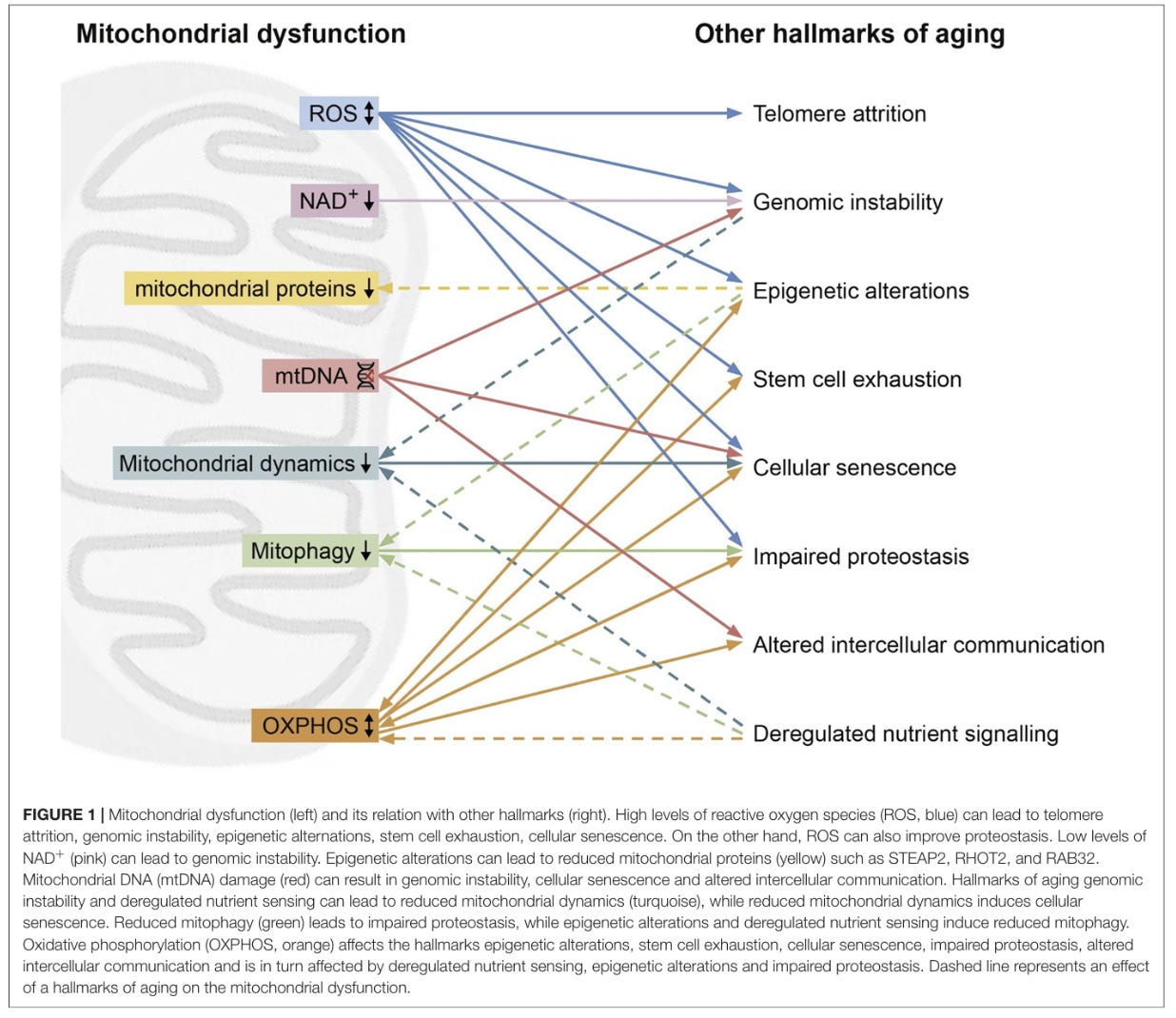
Having both the cognitive understanding and feeling the effects of the body no longer being in the throes of robust development can lead individuals to one of a few choices, including the choice to succumb to the process or a more deliberate intention to mitigate it through lifestyle habits and changes. “Research suggests that generativity can provide a greater motivation to initiate and maintain healthy behaviors” (Cherry, 2024). Cherry (2024) also cites that people operating within the context of generativity, building the skill of healthy contribution supports general feelings of satisfaction with the self and with life. “Generative people are productive in a variety of ways, including teaching, mentoring, and volunteering – both in their personal lives as well as at work” (Cherry, 2024). This is what is known in the Dynamic Flourishing Hierarchy (DFH) as meaningful interconnectedness and purposeful contribution (Perez, 2026b). The simultaneous understanding of how much one has learned and experienced along with the knowledge that decline is just around the corner can be a powerful motivator to be more intentional about one’s choices and overall impact on the world. There is no time like the present moment to either double-down on the choices that brought you to this point of existence or change course in hopes of truly enjoying the descent from the mountain.
References
Cherry, K. (2024, July 14). Generativity vs. stagnation in psychosocial development. Verywell Mind. https://www.verywellmind.com/generativity-versus-stagnation-2795734
Infurna, F. J., Gerstorf, D., & Lachman, M. E. (2020). Midlife in the 2020s: Opportunities and challenges. American Psychologist, 75(4), 470–485.
https://doi.org/10.1037/amp0000591
Perez, G. (2026a). Discussion 1: The thought process with aging [Discussion board post]. Touro University Worldwide. https://portal.tuw.edu/
Perez, G. (2026b). The Dynamic Flourishing Hierarchy: A bio-psychological synthesis of individual sovereignty and collective resilience [Unpublished manuscript]. Master of
Science in Health Sciences Program, Touro University.
Reifman, A., & Niehuis, S. (2022). Extending the five psychological features of emerging adulthood into established adulthood. Journal of Adult Development, 30(1), 6–20.
https://doi.org/10.1007/s10804-022-09412-9
Shuttlesworth, M. (2013, June 7). Development Erikson, adolescence, middle, old age [Video]. YouTube.
van der Rijt, S., Molenaars, M., McIntyre, R. L., Janssens, G. E., & Houtkooper, R. H. (2020). Integrating the hallmarks of aging throughout the tree of life: A focus on
mitochondrial dysfunction. Frontiers in Cell and Developmental Biology, 8, Article 594416. https://doi.org/10.3389/fcell.2020.594416